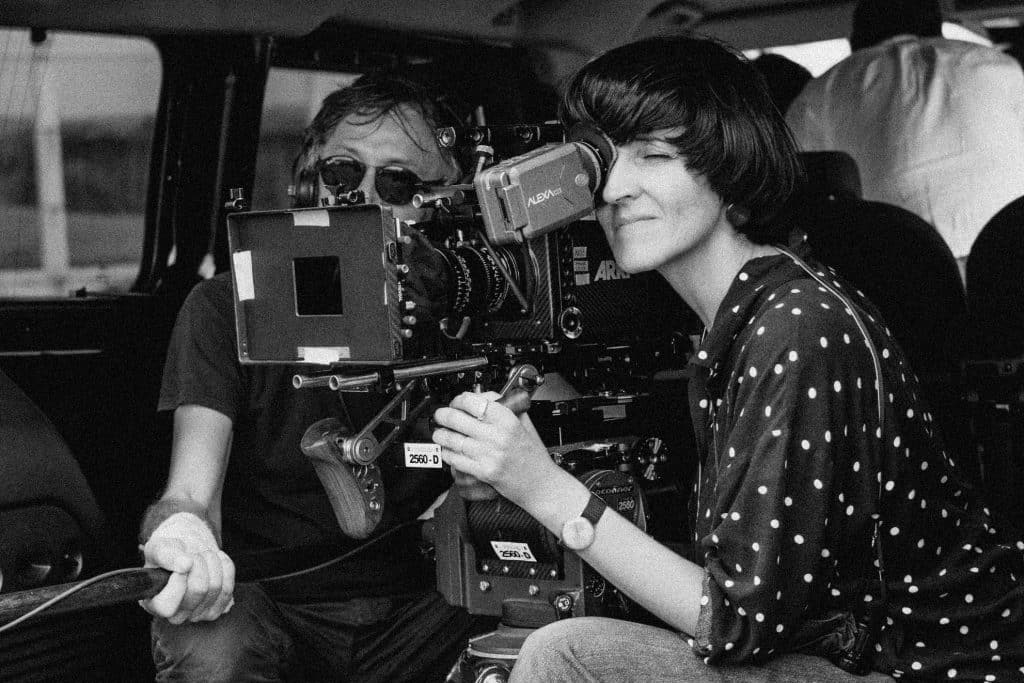
Among Portuguese filmmakers, Cláudia Varejão’s work stands out for the way it explores the borders between documentary and fiction. Born in Porto, Portugal, she studied film at the Gulbenkian Foundation’s Artistic Programme with the German Film und Fernsehakademie Berlin and at the São Paulo International Cinema Academy, in Brazil. She also studied photography at AR.CO, in Lisboa, a background which has proven fundamental in the visual dimension of her work.
Her filmography started out with a trilogy of shorts: Weekend (2007), Cold Day (2008) and Morning Light (2012), bound together by their focus on relationships within families. In 2026, her first feature, Ama-San, premiered to international acclaim. The film follows a community of Japanese women divers, closing in on the the domestic sphere and its smallest gestures, focusing on the intimate relationship between bodies. The film garnered dozens of international awards, putting Cláudia Varejão on the world map of filmmakers working in the space between documentary and fiction.
Since Ama-San, Varejão’s gaze has honed in on the human body: first with In the Dark of the Cinema, I Take Off My Shoes (2016), a film that follows the dancers of the most prestigious dance ensemble in Portugal in their daily and individual struggle, followed by Amor Fati (2020), a philosophical collective portrait built upon faces, bodies and love stories, where film becomes a locus for subjectivity. Amor Fati was the first Portuguese film to debut on the country’s theatres after the covid-19 pandemic lockdown, while also making its way in the international film festival circuit and in movie theatres all over the world.
However, it’s in the following film, Wolf and Dog (2022), that the frontier between genres is given the most thought to. The film follows a community of queer young people in an island in the Azores archipelago, with a cast made up of local non-professional performers. The stuff of fiction therefore rises out of a very close relationship with the people and the place: the director builds out a fictional narrative while preserving the texture and the lived experience of the people who appear on camera. What follows is a film where the line between performance and experience is deliberately blurred. Wolf and Dog premiered worldwide at the 79th edition of the Venice Film Festival, in the Giornate degli Autori section, where it was awarded Best Film by the jury, chaired by Celine Sciamma.
Kora (2024), her most recent work, expanded on that tension between the individual and the political. A short film about refugee women living in Portugal, it is, at heart, an intimate portrait of their ability to reconstruct a life upon fragments of the past, like photographs, with an unequivocal political dimension, a mirror of the historic moment when it was produced, with wars and invasions all over the international news. The film also premiered at the Giornate degli Autori section of the Venice Film Festival, in a special session, wearing its antiwar and feminist colours proudly.
Cláudia Varejão’s cinematic writing refuses rigid borders, both within the work and outside of it. Her films are built in a liminar space between observation and direction, between reality and imagination, between the individual and the community. Gender, identity, migration and freedom arise as subject matters without turning the films into propaganda. The political dimension always arises from the clash between each character and the world around them.
Along with her film work, she keeps up her practice as a photographer and teaches in film and art schools. Her films have been shown in some of the most relevant international film festivals, such as Venice, Locarno, Rotterdam, Visions du Réel, Cinéma du Réel, Karlovy Vary and Art of the Real.